This is a write-up of an earlier course project. The full PDF is linked at the bottom.
Elo and Glicko were built for 1-vs-1 games — chess, most famously. But the games with the largest player bases today are team-based: 5-vs-5 titles like Counter-Strike 2, Dota 2, League of Legends, and Valorant, most of which run tailored variants of Elo/Glicko under the hood. Those ratings aren’t cosmetic — they drive matchmaking, which decides whether your games are balanced or blowouts. So the question this project asks is a practical one: how well do 1-vs-1 rating systems actually hold up as the team size \(n\) grows? The short answer, from simulation, is not well at all — and in a way that gets exponentially worse.
The problem: inferring N skills from one bit of feedback
Every player \(i\) has a latent skill \(\theta_i\) drawn from a population distribution (Glicko assumes \(\theta \sim \mathcal{N}(1500, 350)\)). In any given match, they don’t play at their skill — they play with a noisy performance \(X_i \sim \mathcal{N}(\theta_i, \sigma_i)\), where \(\sigma_i\) is an “inconsistency” parameter. The standard way to extend a 1-vs-1 system to teams is to treat a team as the sum of its parts, which gives a logistic probability that team \(\{1,\dots,n\}\) beats team \(\{n{+}1,\dots,2n\}\):
\[P(\text{team wins}) = \frac{1}{1 + \exp\!\big(\tfrac{1}{173.29}(\textstyle\sum_{j}x_{\text{opp}} - \sum_{i}x_{\text{team}})\big)}.\](The \(173.29 = 400/\ln 10\) scale is the usual Elo logistic constant.) The hard part is now visible: the system observes one bit per match — did this team of \(n\) players win? — and from that stream of bits it has to recover \(n\) separate skill numbers. As \(n\) grows, each individual’s contribution to the outcome is increasingly drowned out by their teammates’, so each game carries less and less information about any one player.
Three algorithms, same blind spot
The project walks through the three canonical systems, each a refinement of the last:
- Elo (1978). After each game, nudge the rating by a fixed step: \(r_k \mathrel{+}= K\sum_i\big(s^i_k - \hat P(\text{win})\big)\). Simple and robust, but it assumes opponents’ current ratings equal their true skill, and has no way to scale the update by how close the game was — a nail-biter and a stomp move your rating identically.
- Glicko (1995). Adds a rating deviation \(RD\) — a confidence interval on the rating. Uncertain ratings (new or inactive players) move fast; well- established ones move slowly. \(RD\) shrinks with every game played and grows during inactivity. This fixes how confident we are, but not what information a game provides.
- Glicko-2 (2012). Adds a volatility term to track players who are actively improving or declining, awarding them more movement. Again: a better model of change, not of team attribution.
Critically, all three see only the win/loss — never who carried the team. The “team = sum of parts” trick keeps the math tractable but throws away exactly the per-player signal the rating is supposed to estimate.
The simulation
To measure the damage: sample a pool of ~20,000 players from \(\mathcal{N}(1500,350)\), initialize everyone at 1500, and play rounds. Each round, matchmaking pairs the best against the best until everyone has a game; outcomes are drawn from the logistic model above; ratings update via Elo. Track the average percentage rank error — how far each player’s estimated rank sits from their true rank —
\[\mathrm{err}_t = \frac{1}{N}\sum_{i=1}^{N}\frac{\lvert \mathrm{rank}^t_i - \mathrm{rank}_i\rvert}{N},\]as a function of games played, sweeping the team size \(n \in \{1,2,3,5\}\).
The result
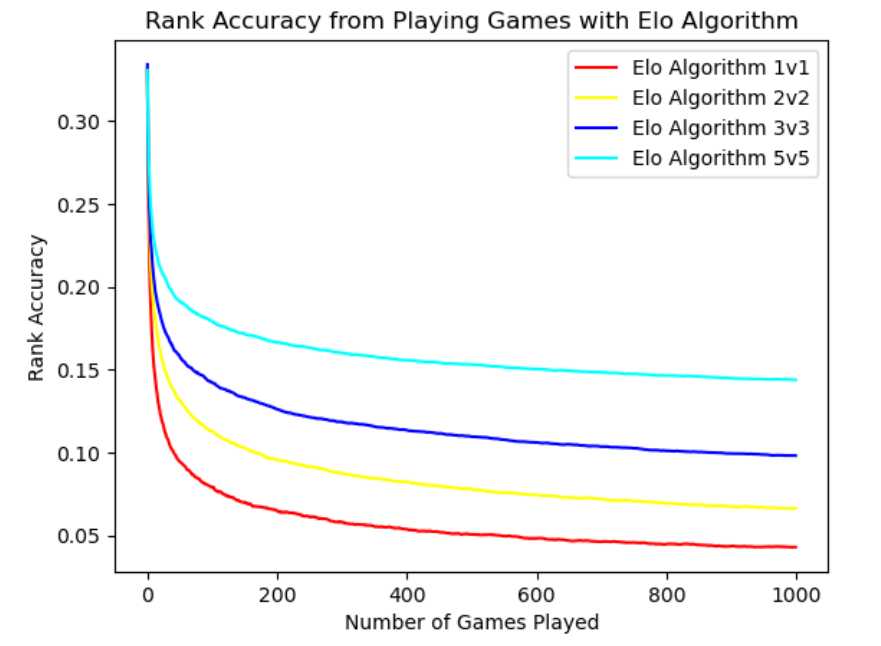
Every curve falls as players accumulate games — but they plateau at dramatically higher error the larger the team. After 1,000 games the average rank error is ≈ 0.043 for 1-vs-1 but ≈ 0.144 for 5-vs-5 — more than 3× worse, and 5-vs-5 is the standard for the most-played competitive titles. For context, most players play fewer than 1,000 games in a year, so in a team game they may never reach a stable, accurate rating.
It’s worse than a constant penalty. If you ask how many games it takes to reach a fixed error target (\(\varepsilon = 0.17\)), that count grows so that \(\log_2(\text{games})\) is linear in \(n\) — i.e.
\[\text{games to reach } \varepsilon \;\approx\; 2^{\,4n/3}.\]Concretely, a 5-vs-5 system needs on the order of 100× as many games as 1-vs-1 to hit the same accuracy. And Glicko / Glicko-2 are expected to fail the same way: their refinements (rating deviation, volatility) address confidence and change, neither of which recovers the individual-performance information that team-only outcomes destroy.
Two deeper cracks
Beyond the scaling, the simulation surfaces two modeling assumptions that don’t hold up:
- The Normal prior is wrong. Glicko assumes skill is \(\mathcal{N}(1500, 350^2)\), but empirical rank distributions in real titles (chess.com, League, CS2, Valorant) are clearly right-skewed — a long tail of high-skill players the Gaussian can’t represent. (Elo’s own literature even suggested a Maxwell–Boltzmann fit.)
- Game closeness is ignored. A 16–14 nail-biter and a 16–0 stomp produce the same rating update. The magnitude of a win carries real information about the skill gap, and these systems discard it entirely.
The takeaway
The core failure isn’t tuning — it’s information. Collapsing a team of \(n\) players to a single win/loss throws away the per-player signal, and no amount of Elo/Glicko machinery (bigger \(K\), rating deviation, volatility) recovers it. The project argues for a rating system designed for \(n > 1\) from the start: one that folds in individual in-game performance metrics — in the spirit of Counter-Strike’s HLTV 2.0 or Leetify ratings — and game closeness, rather than bolting team play onto a 1-vs-1 model. That, of course, introduces its own hard problem: how do you fairly quantify one player’s contribution to a team outcome? — which is exactly where a follow-up would go.
Full write-up (all three algorithms in detail, derivations, and figures): A Case Against Using Elo or Glicko Algorithms for Rating Players in n-vs-n Games (PDF).