arXiv 2610.17375 · 2026

PIG

Parallel Inconsistency Guidance for accelerating diffusion language models

Commit tokens in parallel only while they are predicted to match what decoding them one at a time would give.

Quentin Fruytier · Anton Xue · Sanjay Shakkottai · Sujay Sanghavi

The University of Texas at Austin

The promise, and the gap

Today’s samplers leave most of diffusion’s parallelism unused

Confidence threshold · Fast-dLLM’s rule

2–3×

tokens per forward pass in Nemotron-Labs-Diffusion’s own diffusion mode: 1.9× at 3B, 2.6× at 8B, 2.7× at 14B (ten-benchmark averages)

Oracle · same 8B model, block 32

7.6×

when an oracle picks the commits that reproduce one-slot-at-a-time decoding exactly. Nemotron’s verdict: confidence sampling is “far from optimal”.

Headline speedups add machinery beyond the sampler: Nemotron’s 6× lets its AR mode verify diffusion drafts, and DiffusionGemma’s ~20 tokens per pass comes after retraining with sampler distillation and RL (up from 5).

Speed is tokens per forward pass (TPF): higher is faster. PIG is a better sampler for a frozen model.

Fu et al. 2026 (Nemotron-Labs-Diffusion), Tables 5 and 7, §4.2 (oracle on SPEED-Bench) · DiffusionGemma Team 2026, §5

2

The catch

Tokens decoded together never see each other

Each slot is plausible on its own; the pair is not. Probabilities are illustrative (after the paper’s dog / cat example).

PIG · arXiv 2610.17375

3
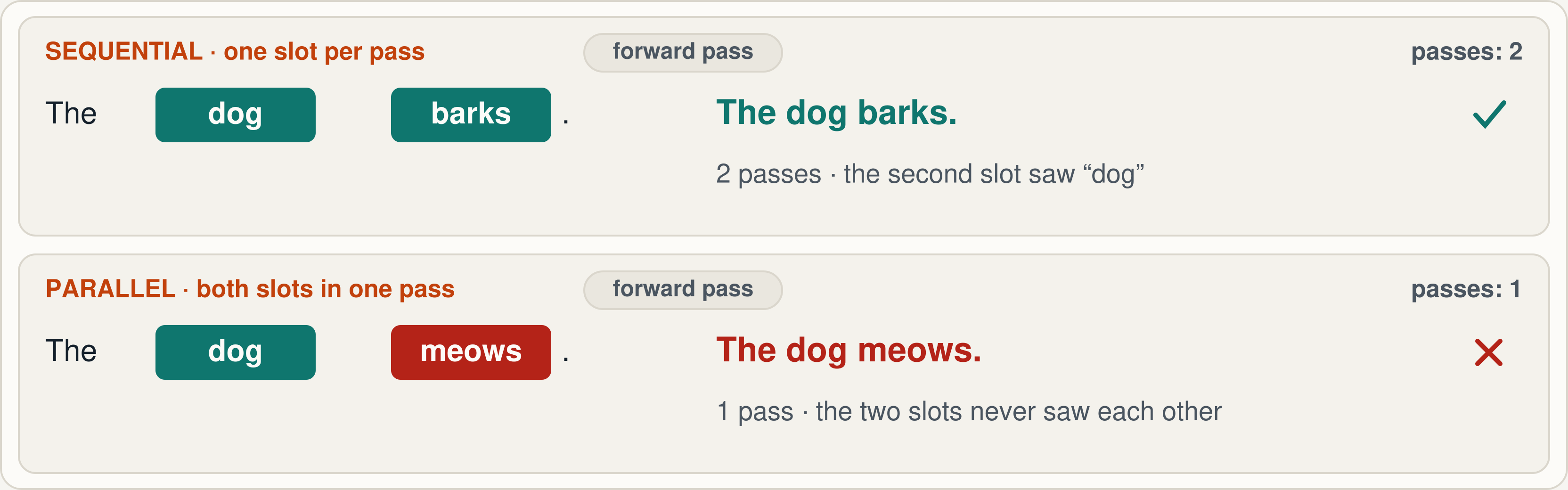
Final frame: sequential decoding gives The dog barks in 2 passes; parallel decoding gives The dog meows in 1 pass

The paradigm

Trajectory tracking: commit in parallel, stay on the sequential path

Confidence

Fast-dLLM

Commits every slot the model is sure of, many per pass.

On its own: blind to coupling. Two confident slots can still contradict each other.

+

Valid joint sampling

Sequential decoding

Each token sees the ones before it, so the text is a valid sample of the model’s joint distribution. Independence rules (DAPD, DEMASK) only test that slots look uncoupled.

On its own: one token per pass.

→

Trajectory tracking · PIG

Both, supervised

Commit in confidence order, as many slots as keep the output equal to the sequential decode.

Observable target: replay any set one slot at a time and check whether a token changed.

Matching the sequential trajectory asks for more than independence, and decoding one slot at a time supplies the labels. Parallel decoding becomes a supervised task.

Wu et al. 2025 (Fast-dLLM); Kim et al. 2026 (DAPD); Ringel et al. 2026 (DEMASK)

4

The objective

One round is a budgeted selection

maximise |S| subject to R(S) ≤ φ

R(S) = the number of slots in S whose parallel token differs from the token sequential decoding would give. Computing it exactly costs |S| extra passes.

Idea 1

Confidence order turns search into a prefix

Scan masked slots by decreasing confidence. The only decision left is where to stop.

Idea 2

Regret is predictable from one pass

A slot flips only if the set moves its distribution past its top-1 margin: confidence gives the margin, pairwise effects give the push.

PIG · arXiv 2610.17375 · Section 3

5

The estimator

One adapter predicts every pairwise effect

Entry (i, j) ≈ entropy at i now − entropy at i after committing j · values from the paper’s Figure 4

6
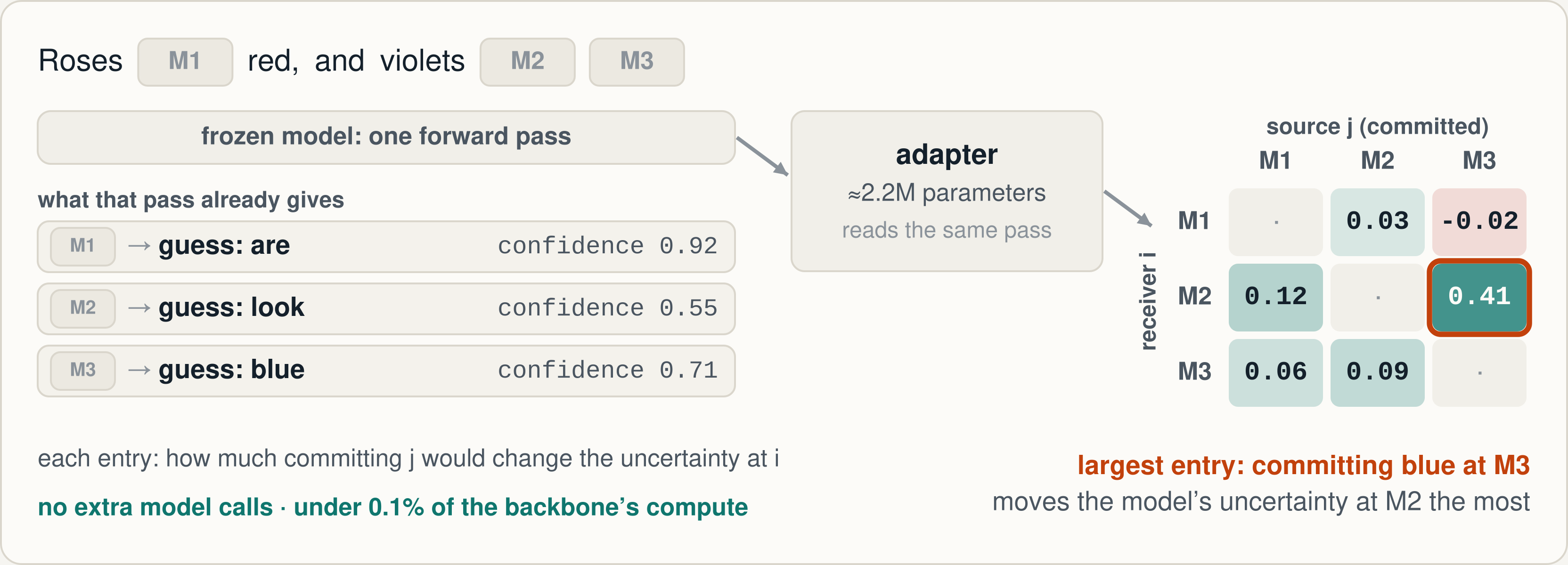
Final frame: the adapter reads the same forward pass and fills the 3 by 3 matrix of pairwise effects; the largest entry, 0.41, is committing blue at M3 on M2

Decoder 1 · single-round regret

PIG.INT: admit by confidence until φ is spent

The paper’s Figure 2 example, played through to the end · φ = single-round regret budget

7
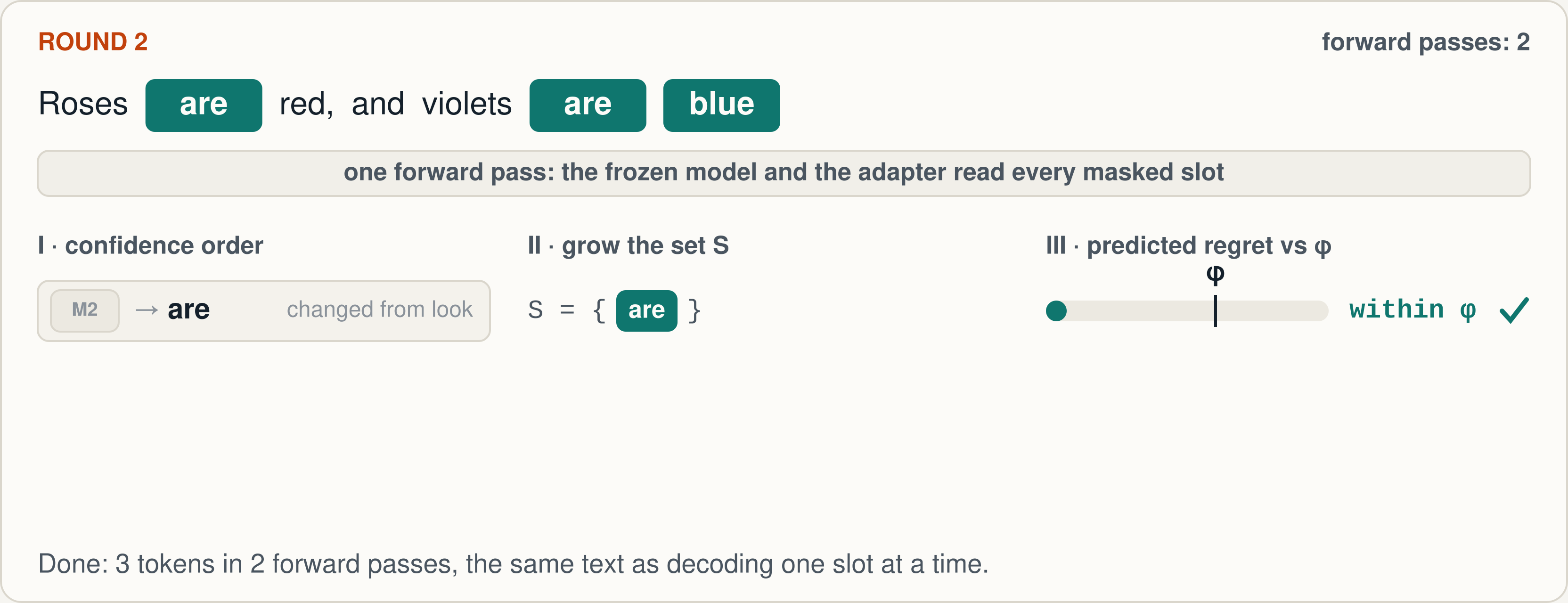
Final frame: round 2 commits are at M2 within the budget phi; 3 tokens in 2 forward passes, the same text as sequential decoding

Decoder 2 · cross-round regret

PIG.EXT: stop early when waiting is worth more than θ

Paper’s Figure 3 example · value of waiting: how much the next slot’s risk drops if S commits first

8
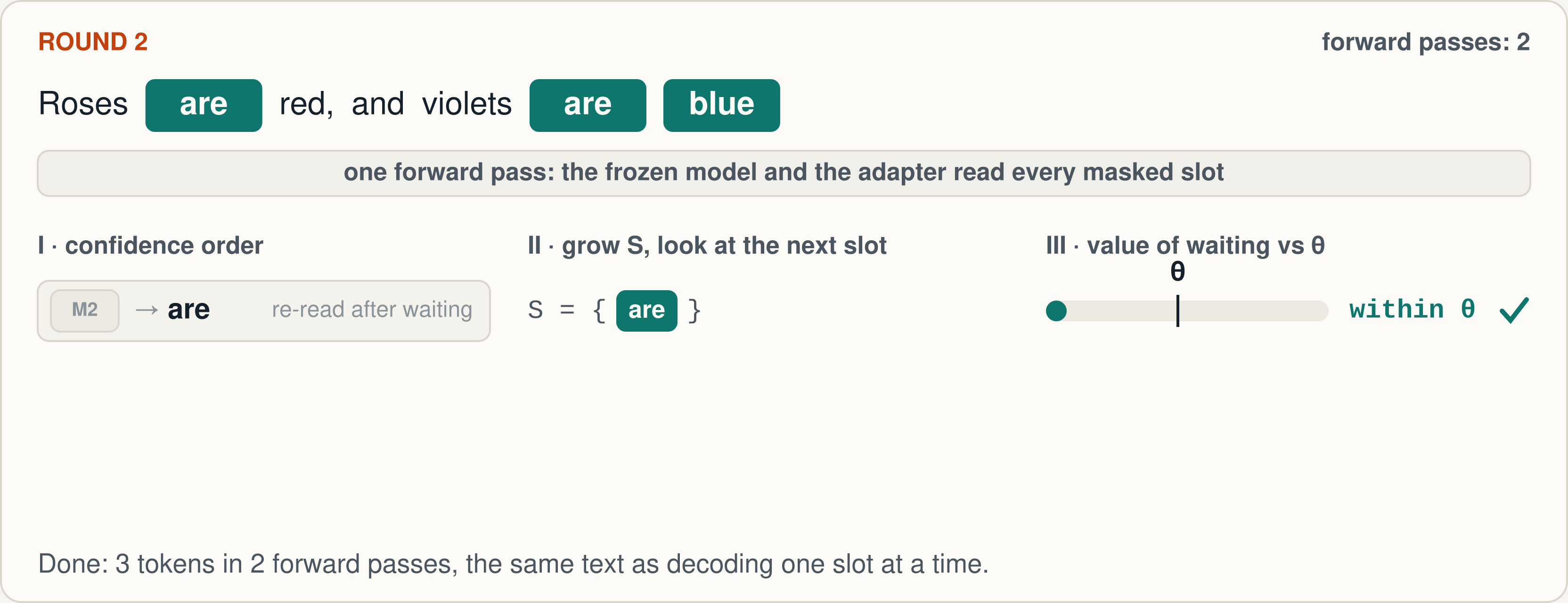
Final frame: round 2 commits are at M2 after re-reading it, within theta; 3 tokens in 2 forward passes, the same text as sequential decoding

A real decode · LLaDA-8B-Instruct, HumanEval

The same program in 19 passes instead of 30
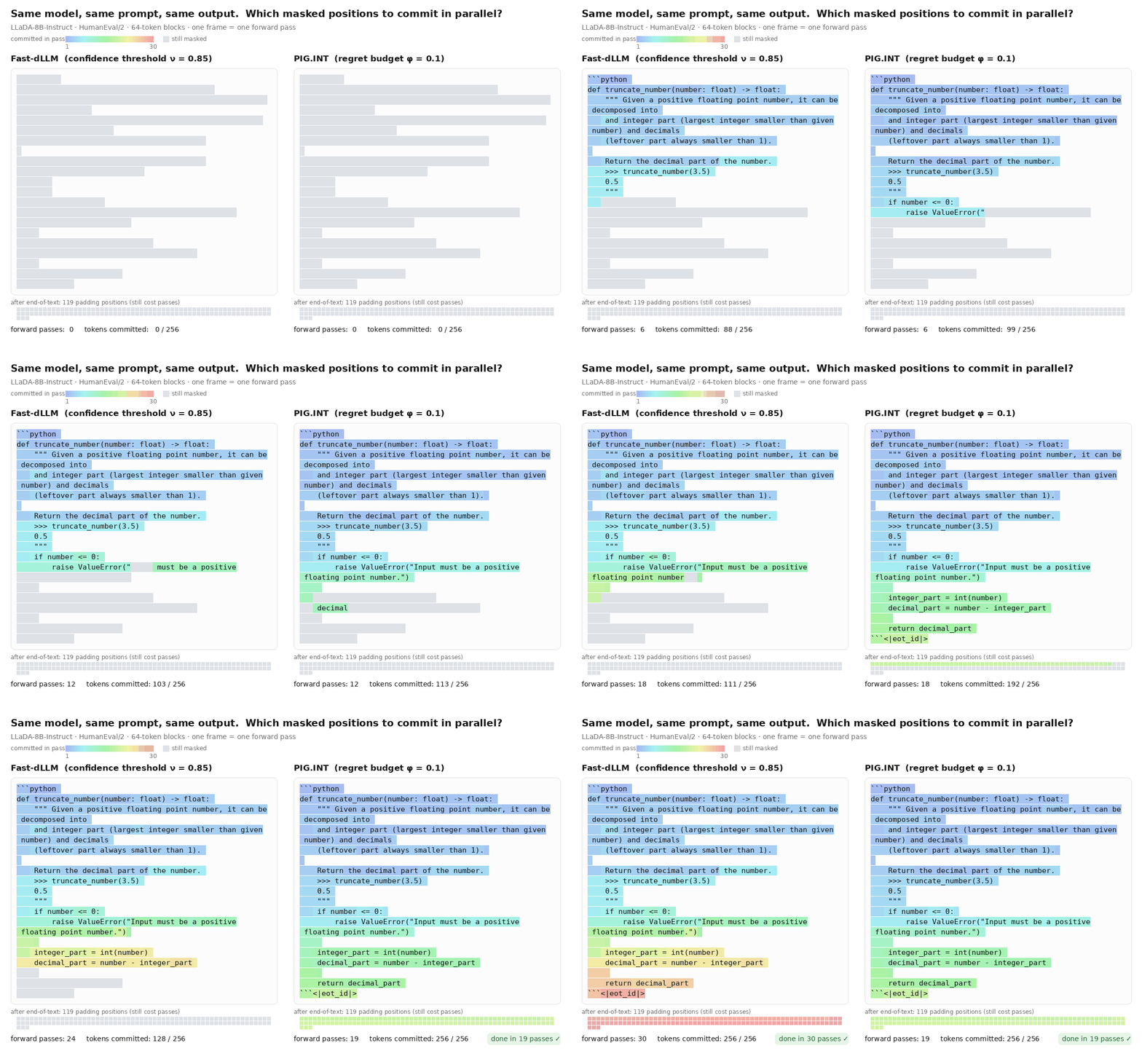
Fast-dLLM and PIG.INT decoding the same HumanEval problem side by side; every frame is one forward pass

30

passes · Fast-dLLM

19

passes · PIG.INT

Same model, same prompt, identical program. Each frame is one forward pass; colour marks the pass that committed the token.

All 164 HumanEval problems at this setting: 7.2 vs 10.1 tokens per pass, 36% vs 34% pass@1 (64-token blocks)

9
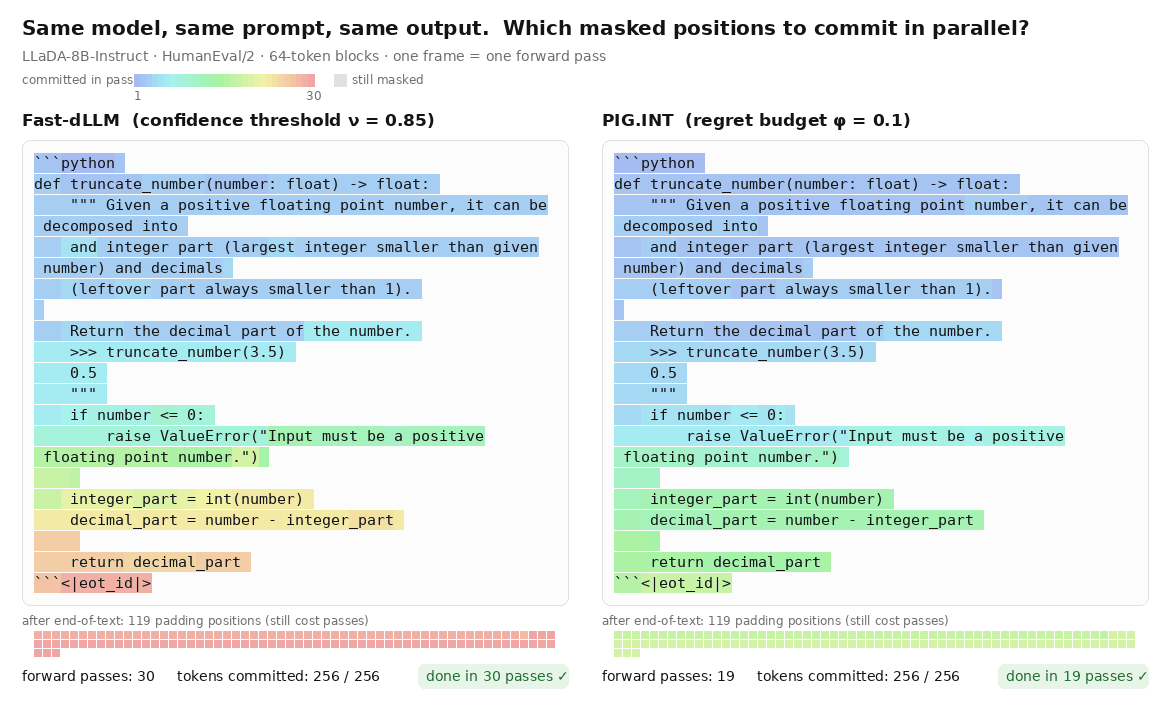
Final frame: Fast-dLLM done in 30 passes and PIG.INT done in 19 passes, same program

Results · four benchmarks, two model families

PIG extends the accuracy–speed frontier
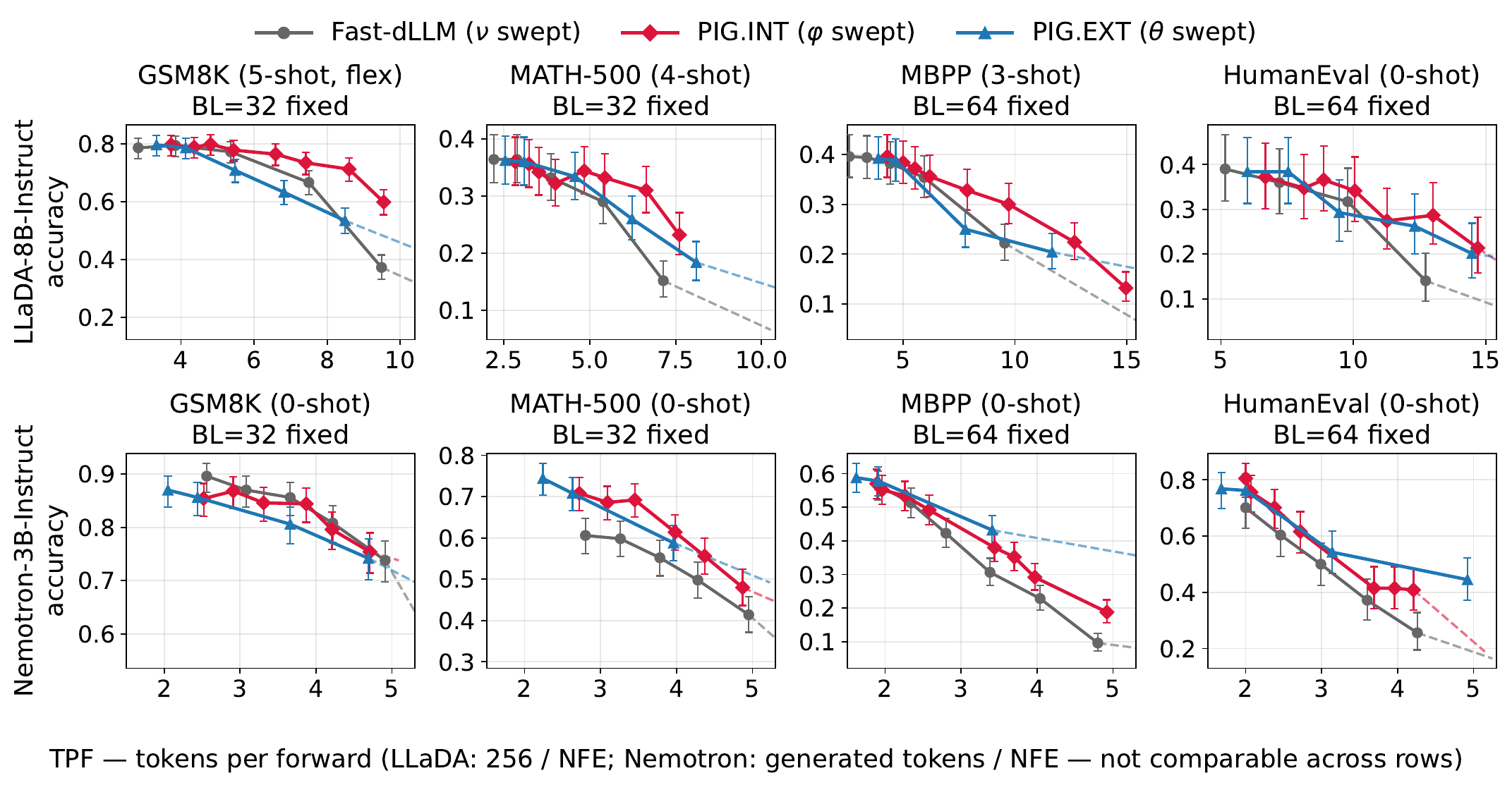
Accuracy against tokens per forward pass on GSM8K, MATH-500, MBPP and HumanEval for LLaDA-8B-Instruct and Nemotron-3B-Instruct: PIG.INT and PIG.EXT above Fast-dLLM

1.7×

up to Fast-dLLM’s tokens per pass at matched accuracy, LLaDA-8B

1.4×

over Nemotron’s native confidence decoder

+28

accuracy points kept at the baseline’s fastest settings

Accuracy vs tokens per forward pass (up and right is better) · Wilson 95% bars · one adapter per model

10

Audit · replaying every committed set one slot at a time

Predicted regret tracks realized regret
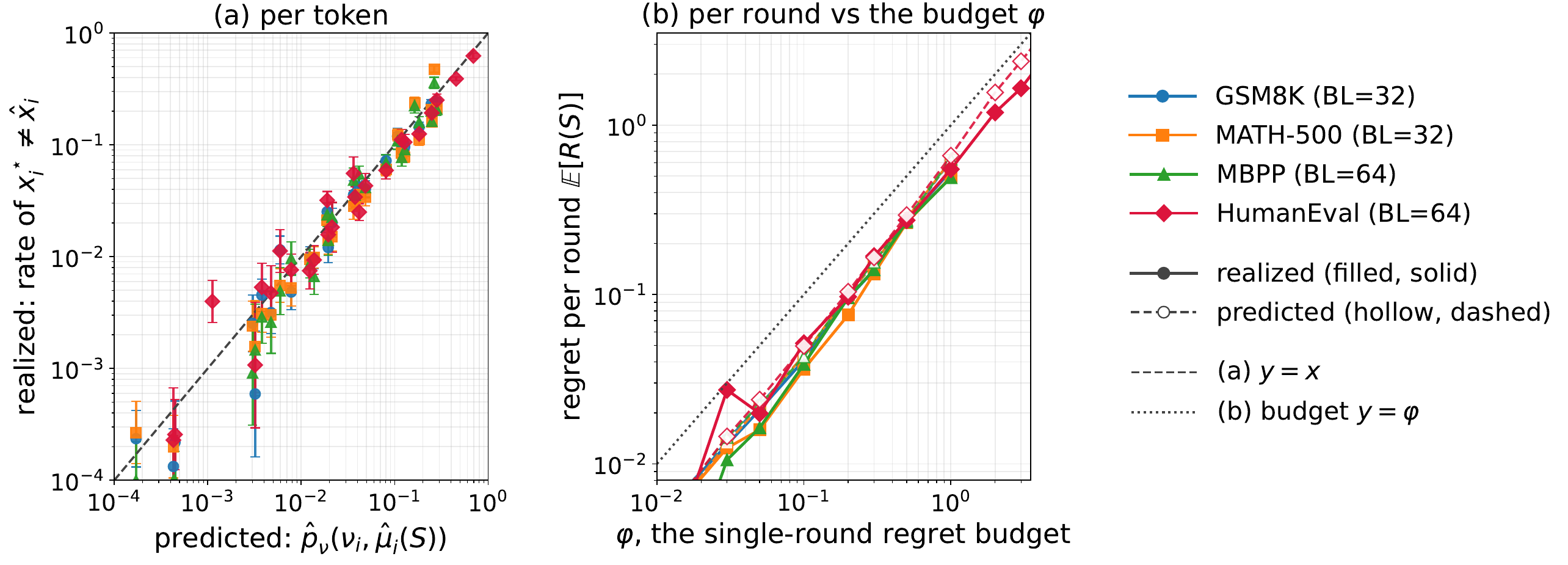
Two panels: per-token predicted vs realized mismatch rate on the diagonal; realized regret per round below the budget phi at every setting

LLaDA-8B-Instruct · (a) per token, on the diagonal · (b) per round, below the budget φ at every setting

11

Takeaways

Decode in parallel only where it would not change the answer

A new target

Control disagreement with sequential decoding, not a proxy for independence.

Predictable in one pass

A 2M-parameter adapter on the frozen model, trained once per backbone.

Faster at equal accuracy

Up to 1.7× Fast-dLLM on LLaDA and 1.4× Nemotron’s own decoder.

arxiv.org/abs/2610.17375

github.com/Quentin-Fruytier/PIG-DLM-release

huggingface.co/UT-IFML
LLaDA-8B-Instruct-PIG · Nemotron-Labs-Diffusion-3B-PIG

Joint work with

Anton Xue

Anton Xue

Sanjay Shakkottai

Sanjay Shakkottai

Sujay Sanghavi

Sujay Sanghavi

The University of Texas at Austin

Backup · the estimator’s adapter

A 2.2M-parameter adapter, fit once per backbone on exact labels

Architecture

Frozen DLM, the one forward pass

per slot: last hidden state, token id, entropy, confidence, margin, decode fraction t · attention maps of this round and the last

↓

Adapter · the only trained part

Embed each slot into 192 dimensions

Mix with 2 transformer layers over the canvas, conditioned on t, with a bias read from the model’s attention

Read out a directed score per pair:f(zi)⊤ W g(zj) + bij

↓

All 256 × 256 pairwise effects, in the same pass

under 0.1% of a backbone pass · 12.8 ms per round on an H100

Training, offline

1

Harvest states. Decode training-split problems (GSM8K, MATH, OpenCoder, MBPP) with the frozen model; snapshot every 24 commits. 34,142 states from 3,721 problems.

2

Label exactly. Commit one slot j and re-run the model: one extra pass gives a whole column of true effects. 24 slots per state (16 most confident, 8 random): 111M labelled pairs.

3

Fit. Huber loss on the labelled entries only, split by problem. Per-pair correlation 0.83 on validation, about 0.8 on the test benchmarks.

4

Calibrate. Replay candidate sets one slot at a time; a frozen table turns (confidence, coupling) into the chance a token differs from sequential decoding.

LLaDA-8B-Instruct shown · Nemotron-3B twin: same recipe within one block, validation r = 0.79

B1

Home Paper PDF ← → to move · P to pause on the final frame · F full screen